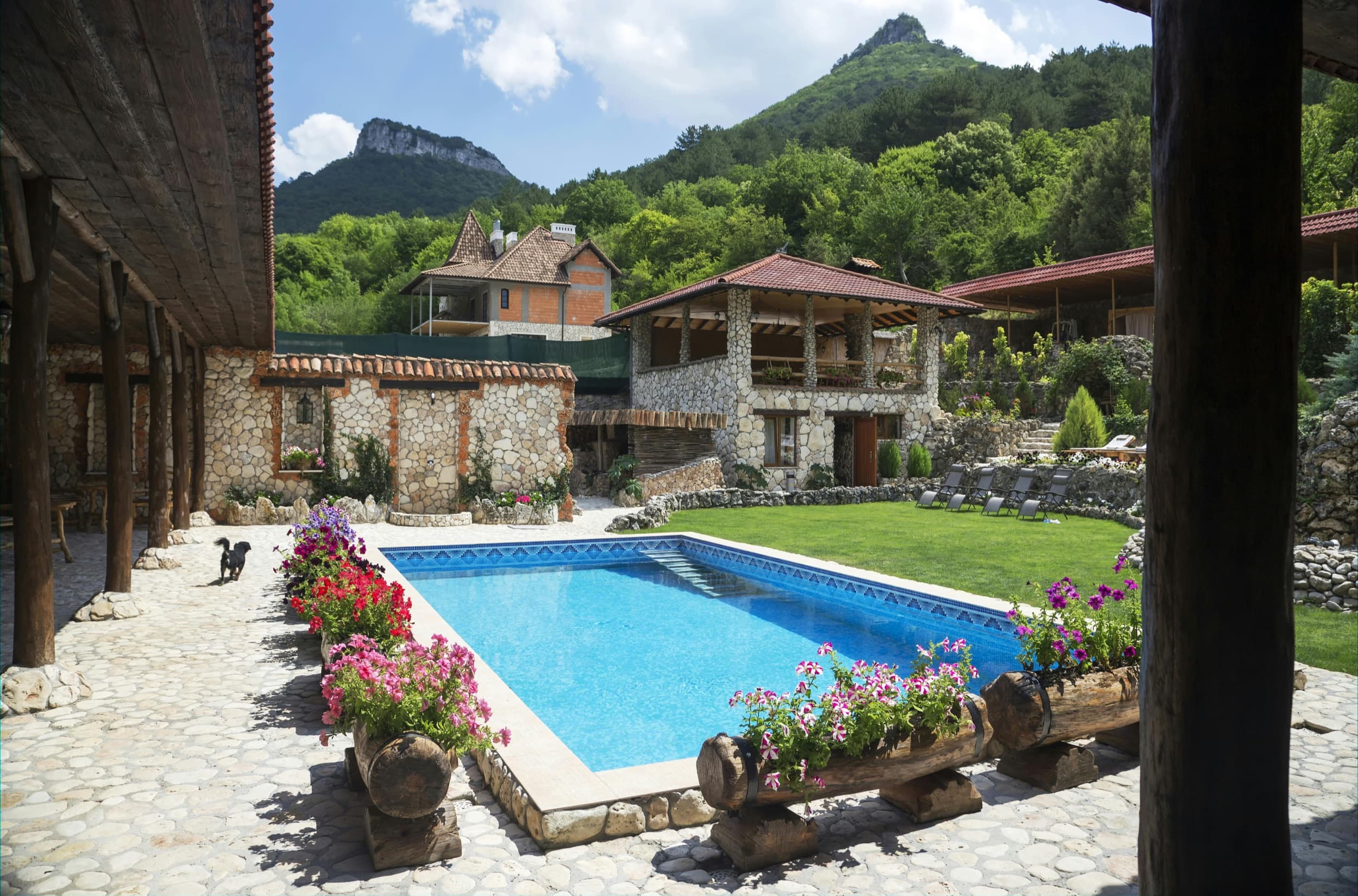
The honest comparison between a staffed villa vs luxury hotel doesn't show up in the first 48 hours. Anywhere with good linens and a decent restaurant can carry a weekend. The difference shows up on day four, day seven, day eleven — when the rhythm of the trip either belongs to you or belongs to someone else's operating manual. For a 14-day stay, that difference is the entire trip.
I've booked both sides of this for clients for years, and I've stayed on both sides myself. What follows is not a pitch for one over the other. It's what actually changes, operationally and experientially, when you commit two weeks to a private villa with a full house team instead of a suite at a five-star hotel.
The economics stop being about the nightly rate
On a three-night trip, a hotel almost always wins on math. You're paying for a room, a bed, and access to amenities that were built for two hundred guests. Spread across three nights, the per-night rate looks reasonable and the fixed costs of a villa — the house manager, the chef, the pre-arrival provisioning — don't have time to amortize.
At fourteen nights, the math inverts. A four- or five-bedroom villa in the Caribbean, the South of France, or Tuscany typically prices per week, and the staff cost is folded in or added as a flat weekly figure rather than a per-service charge. Every espresso, every poolside lunch, every bottle of rosé at sunset is not a line item. You're not signing a check at every meal. Over two weeks, with a family of six or eight, the arithmetic on food and beverage alone reshapes the comparison — hotel F&B on a long stay is where the bill quietly triples.
But the real economic argument isn't the number at the bottom. It's what you get for it. A hotel suite is optimized for a room-nights business model — high turnover, standardized service, a payroll structured around shift work. A villa is optimized for one booking at a time. The chef is cooking for your table, not seventy covers. The housekeeper is cleaning your rooms, not fourteen of them.
What a hotel does better on a long stay
Credit where it's due. Hotels win on a few things and it's worth being clear about them:
- Spa and gym infrastructure. A serious hotel spa with a full treatment menu and a proper gym is difficult to replicate at a villa, though most villas can bring in a trainer or a masseuse on call.
- Kids' clubs and structured programming. If you want your children off your hands from 9 to 5 with certified staff, resorts are built for that.
- Anonymity in the public spaces. Some travelers actively want to walk through a lobby and disappear into a crowd. A villa doesn't offer that.
- On-property variety. Four restaurants, three pools, a beach club. A villa is one property with one pool.
If those are non-negotiable, book the hotel. If they're not, keep reading.
The staff is the entire product
A good hotel is a system. A good villa is a small team that works for you and only for you for the length of your stay. That distinction is everything.
A typical fully staffed villa in the €25k–€60k/week range in the Mediterranean will come with a house manager (sometimes called an estate manager or majordomo), a private chef, one or two housekeepers, a laundress, a gardener who's around during daylight, a pool attendant, and often a driver. Some properties include a dedicated butler. Larger estates layer on a sous chef, additional service staff, and a nanny on request.
What that means in practice on day three: the chef has learned that your youngest doesn't eat anything green, that you take your coffee before anyone else is up, that your partner drinks Sancerre and not Chablis, and that Tuesday nights are for grilled fish on the terrace. The housekeeper has figured out which side of the bed you sleep on and stops turning down the other one. The house manager has booked the boat, the wine tasting, and the babysitter for the night you want to go out to dinner alone.
A hotel cannot do this. Not because the staff aren't good — some of them are extraordinary — but because they rotate shifts, work multiple rooms, and answer to a chain of command that isn't yours. On a 14-day stay at a hotel, you will explain your coffee order to a different person seven times.
The preference sheet is the whole game
When we book a staffed villa, the property sends a preference sheet a few weeks before arrival. It reads like the intake form for a private flight department — dietary restrictions, allergies, brands of spirits and mixers, preferred bottled water, breakfast times, whether you want the fridge stocked with a specific type of yogurt, whether the kids need a specific brand of sunscreen, whether you want fresh flowers or find them cloying, what time you want the pool heated in the shoulder season.
That sheet goes to the house manager, who provisions the villa before you land. When you walk in, the pantry is yours, not the hotel's. That single detail — walking into a house where the fridge already knows you — is what people mean when they say a villa "feels different." It's not decor. It's logistics done in advance on your behalf.
The day has a different shape
Hotels optimize for throughput. Breakfast ends at 10:30 because the room has to be reset for lunch. The pool towels get handed out from a stand. Dinner is booked in seatings. None of this is bad — it's just built around a business that needs to process a lot of guests through a finite number of spaces.
A villa runs on your clock. Breakfast is when you come downstairs. If that's 7:15 for the early risers and 11:00 for the teenagers, the chef handles both. Lunch is on the terrace or by the pool or not at all, depending on whether you went out on the boat. Dinner is at 8, or at 10 after you get back from a long lunch in town, and the table is set the way you like it because someone watched the way you moved through the first three nights and adjusted.
The other thing that changes: the trip stops being a series of reservations. At a hotel, a two-week stay is 42 meals, each of which is a decision — which restaurant, what time, who's coming. At a villa, most of those meals are handled. You eat in three or four nights a week without thinking about it, go out when you actually want to go out, and the going-out becomes an event again instead of the default.
Privacy at a different order of magnitude
Hotel privacy is discretion — staff trained not to acknowledge who you are, side entrances, private elevators for the top-floor suites. It works, mostly. But you're still sharing space with several hundred strangers.
Villa privacy is architectural. The property is gated, the staff have signed NDAs where appropriate, and the only people on the grounds are the ones you invited or hired. For clients who travel with security, with sensitive business happening on the trip, or simply with a family that doesn't want to be photographed by the pool, this is not a small thing. It's often the reason the villa gets chosen in the first place.
What breaks, and how to keep it from breaking
Villas fail when the operational layer around them is thin. The house is beautiful, the staff is competent, but there's no one coordinating the arrival, the ground transfer, the provisioning, the boat charter, the day trips, and the departure. You end up doing that coordination yourself, which is the opposite of the point.
The things that go wrong on a two-week villa stay, in rough order of frequency: the chef isn't the chef you were promised (a substitute got slotted in and no one told you), the provisioning missed something specific from the preference sheet, the ground transportation is a local taxi instead of a proper car and driver, the villa's Wi-Fi can't handle a family of eight streaming and taking calls, and — the classic — the day-of-arrival timing is off and you land at the villa before the house is ready.
All of these are preventable. They get prevented by whoever booked the villa staying involved through the arrival and the first 48 hours, and by treating the villa as one component of a trip rather than a standalone booking. Ground, air, provisioning, and any supporting travel logistics need to be coordinated by the same person, not stitched together from four different vendors who don't know each other.
When two weeks becomes the right length
Something shifts around day eight or nine of a villa stay. You've done the excursions you planned. The kids know the pool. You've figured out which market has the good tomatoes and which beach is worth the drive. The second week stops being a trip and starts being a life you're briefly borrowing. That doesn't happen at a hotel. Two weeks at a hotel is a long hotel stay. Two weeks at a villa is a season, compressed.
If you want to talk through a specific property, a specific date, or how the staffing on a particular villa actually holds up in practice, get in touch directly — the honest answer usually depends on the region, the operator, and the time of year.
FAQ
Is a staffed villa more expensive than a luxury hotel for two weeks?
Not usually, once you account for the total spend. The nightly rate on a villa often looks higher than a hotel suite, but food, beverage, and service are typically bundled or billed at cost rather than at hotel markup. For families of four or more staying two weeks, the villa is frequently cheaper on the final bill, and gives you significantly more space and staff attention.
How much staff comes with a fully staffed villa?
It depends on the property, but a well-run four- to six-bedroom villa in the Mediterranean or the Caribbean typically includes a house manager, a private chef, one to two housekeepers, a laundress, a gardener, and a pool attendant. Larger estates add sous chefs, additional service staff, drivers, and nannies on request. Staff are usually on-site during daytime hours with a house manager reachable around the clock.
Can I get hotel-style amenities like a spa or gym at a villa?
Some villas have full gyms and treatment rooms built in. Where they don't, the house manager brings in trainers, masseurs, and yoga instructors on call — often at a lower cost than the hotel spa and always on your schedule. A serious multi-treatment spa with saunas and hydrotherapy is one thing hotels genuinely do better.
What is a preference sheet and why does it matter?
A preference sheet is a document the villa sends before arrival, covering dietary needs, brand preferences, schedule, and specific requests down to the type of bottled water and the temperature of the pool. It matters because it lets the staff provision and prepare the house before you land, so the first day feels like the fifth day. Hotels don't do this at the same level of detail on standard bookings.
How far in advance should I book a staffed villa for a two-week stay?
For peak season in top regions — July and August in the South of France, Christmas and New Year in the Caribbean, August in Sardinia — the best staffed properties are often held six to twelve months out. Shoulder season bookings can come together in six to eight weeks. Last-minute is possible but the pool of properties shrinks quickly.
What happens if something goes wrong mid-stay at a villa?
At a good villa, the house manager handles it — a broken appliance, a staff issue, a change in plans. When the booking is done through a collective rather than directly with an owner, there's a second layer: someone off-site who can escalate, replace staff, or move you to another property if the situation warrants. That second layer is what you're paying for on top of the villa itself.
Two weeks is a real amount of time. Spend it somewhere that's built to hold it.