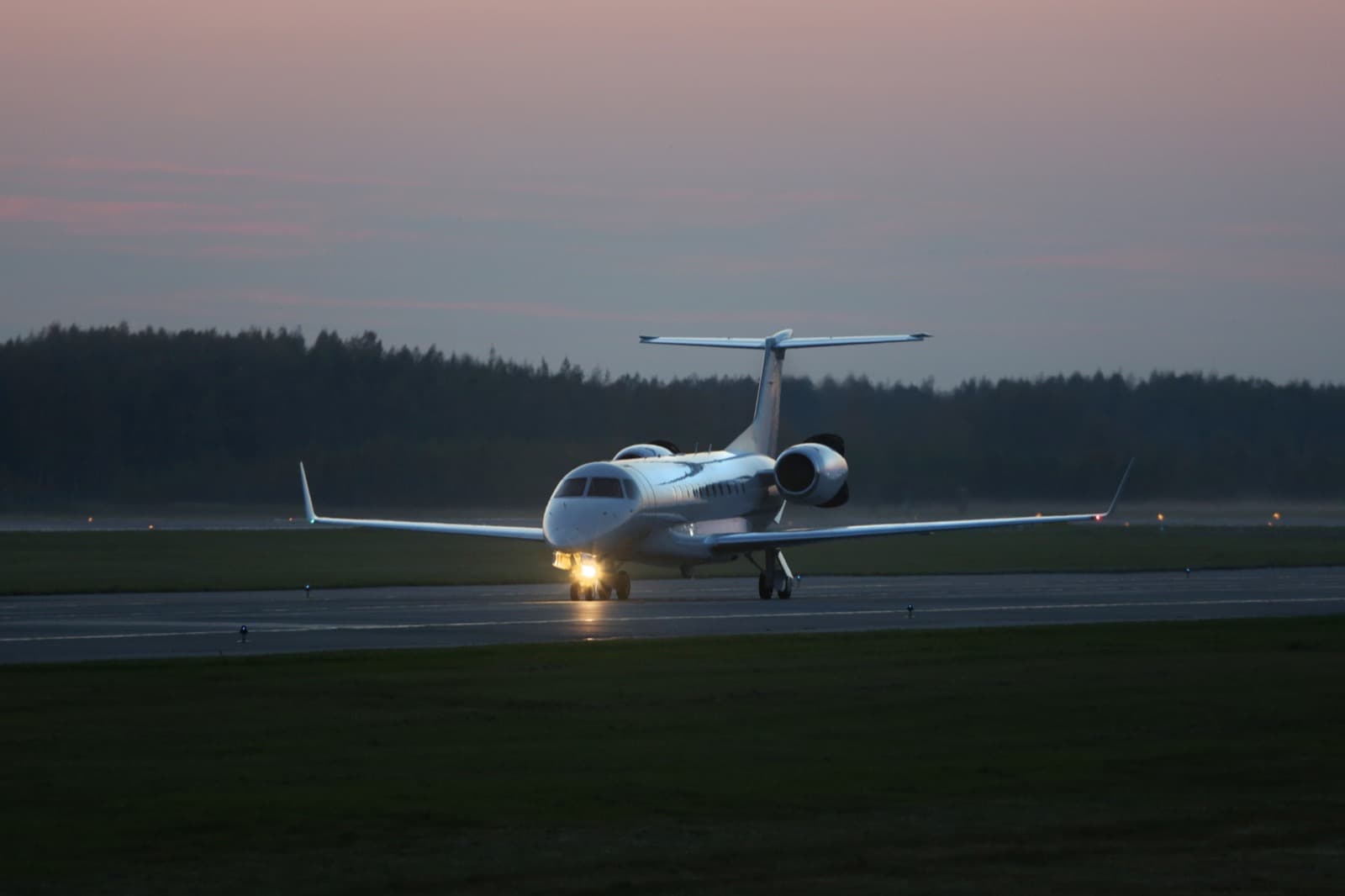
Flying private to the Monaco Grand Prix 2024 is not a charter booking — it is a logistics operation that starts six weeks out and finishes when your tender clears the harbor on race night. The 81st running of the Grand Prix de Monaco goes green on Sunday, May 26, 2024. Practice opens Friday the 24th, qualifying Saturday the 25th. If you are flying in from the East Coast, that means a Thursday or Friday departure from Teterboro, a fuel-stop or nonstop transatlantic, and a Nice arrival into one of the most slot-constrained windows on the European calendar. The aircraft is the easy part. Everything around it is the work.
What follows is how the week actually runs from the inside — what we ask, what we book, what we watch the day-of. If you have done Monaco before, some of this will be familiar. If this is your first race, read it twice.
The transatlantic leg: TEB to NCE in one move or two
From Teterboro to Nice Côte d'Azur (LFMN) is roughly 3,950 nautical miles great-circle. That is a nonstop sector for a Global 6000, Global 7500, Falcon 7X/8X, Gulfstream G550 and up, and the Bombardier Challenger 650 in favorable winds with a light cabin. Anything smaller — Challenger 350, Praetor 600, Citation Longitude — is a tech stop. The usual fuel stops are Bangor (KBGR), Gander (CYQX), Goose Bay (CYYR), or Keflavik (BIKF) on the way out, then a straight shot into LFMN. Plan on roughly seven to eight hours block-to-block nonstop, ten to eleven with a tech stop including ground time.
The choice between nonstop and one-stop is not just about cabin size. It is about crew duty day, headwinds in May (typically 40–80 knots on the nose at FL410 westbound, tailwind eastbound), and what you want to do when you land. A heavy jet that lands you in Nice at 9 a.m. local with the cabin still dark and breakfast service done is a different trip than a super-mid that lands at 1 p.m. after a fuel stop, with the crew about to time out. We pick aircraft for the mission. That is the entire premise of how Revenant sources jets — operator-first, not broker board.
Why eastbound timing matters this week
LFMN runs slot coordination year-round, but Grand Prix week is its own animal. The airport publishes a special operations notice every May with restricted slot allocation for general aviation arrivals and departures Thursday through Monday. Slots are issued in 15-minute windows. Miss yours by more than the tolerance and you go to the back of the queue, which during race week can mean a two- to four-hour hold or a divert to Cannes-Mandelieu (LFMD) or Saint-Tropez (LFTZ). LFMD has a 22-metric-ton MTOW limit and a 1,600-meter runway — fine for a Phenom 300 or Citation XLS, not fine for a Global. Plan the slot first, then back-solve the departure time out of TEB.
Landing at Nice and getting to Monaco
Nice Côte d'Azur is a commercial airport with a dedicated business aviation terminal — the Aviapartner Executive FBO on the south side, opposite the main commercial terminals. Customs and immigration clear at the FBO. On a normal week that takes ten minutes. During Grand Prix week, with arrivals stacked from late Wednesday onward, expect 20 to 40 minutes if you are not the only aircraft on the ramp. Crew handles the paperwork; you wait in the lounge.
From NCE to Monaco is 22 kilometers as the crow flies and three transport options that each have a different personality.
Helicopter. Monacair runs scheduled and on-demand shuttles between NCE and Monaco Heliport (Fontvieille). Block time is seven minutes airborne, fifteen minutes door-to-door including transfers. During race week the heliport runs a published noise-abatement schedule and slots fill early. Book the helicopter when you book the jet, not when you land.
Car. A1 to the A8 east, exit at La Turbie or Roquebrune. Fifty minutes on a quiet Tuesday. Two and a half hours on Thursday afternoon of race week. Three on Sunday morning if there has been an incident on the autoroute. Possible, not pleasant.
Boat. Underrated. A tender from Cap d'Ail or Beaulieu-sur-Mer into Port Hercule takes 15 to 25 minutes and bypasses the road grid entirely. If you are staying on a yacht for the week — more on that below — your captain will collect you.
We pre-position ground vehicles and the helicopter the day before. The car at the FBO curb is the quiet hinge of the whole trip; if it is wrong, the morning unravels. We do not let it be wrong.
Where you actually watch the race
Monaco's circuit is 3.337 kilometers of public road that gets bolted into a Formula 1 track over four days in May. There are essentially three viewing economies — grandstand, terrace, and harbor — and the trip you book six weeks out determines which one you have access to.
Grandstand and terrace
The principal grandstands are K (start-finish), T (Tabac), and the Piscine sections around the swimming pool complex. Hospitality terraces — the Amber Lounge, the Ermanno Palace, Paddock Club — sit above the circuit at named buildings. These sell out months in advance. By April for the May race, you are buying resale. Hotel-attached terraces (Hermitage, Fairmont hairpin) book through the hotel and require a room reservation, which itself runs four nights minimum at race-week rates.
Harbor — the yacht play
The yachts berthed in Port Hercule from Wednesday through Monday are the best seats on the circuit. The Tabac-to-Piscine section runs along the quay; from a flybridge you are looking down at the cars. The harbor is managed by the Société d'Exploitation des Ports de Monaco and berths are allocated by application — most go to repeat clients and the same brokerage houses every year. What is available to a new client is almost always a charter on a yacht that already holds a confirmed berth.
This is why the yacht conversation has to happen before the jet conversation if harbor viewing matters to you. A 35–50 meter motor yacht with a Port Hercule berth for race week, fully crewed, with chef, is the trip a lot of clients want and only some of them get. We start that conversation in February. If you are reading this in May 2024 for the 2025 race, now is the right time. Look at yacht charter for the long-form on how that side works.
What we actually do in the six weeks before the race
A Grand Prix week trip has roughly forty moving parts. Here is what sits on the operational checklist:
- Aircraft sourced and contracted, with a backup operator identified for the same tail category in case of mechanical
- LFMN arrival slot filed and confirmed; LFMN departure slot for Sunday night or Monday morning filed and confirmed
- Tech stop coordinated if applicable, with handler standing by at BGR, CYQX, or BIKF
- Crew accommodations in Nice or Antibes — not Monaco, the rooms are gone and the rates are punitive
- FBO ground services at NCE: customs pre-notification, catering, fuel uplift for the return, lavatory service
- Helicopter or car transfer NCE-Monaco both directions, with the return staged 90 minutes before slot
- Villa or yacht confirmed, with provisioning list submitted to the chef
- Race tickets or harbor berth credentials issued and matched to passport names
- Restaurant reservations — the good ones in Monaco for race week close their books in March
- Medical and security contacts on file with the local concierge
None of this is glamorous. All of it is the difference between a great trip and a frustrating one. The point of working with a private travel collective is that you do not assemble this list yourself.
Departure: getting out of LFMN on Sunday night or Monday
The race finishes around 5 p.m. local. The airport's general aviation departure window between 6 p.m. Sunday and noon Monday is the single busiest period of the European business aviation calendar. Slots in that window are gold. We file the departure slot at the same time as the arrival — losing it because you wanted to keep options open is not a trade we make.
If the trip continues — Sardinia, Mykonos, Ibiza for the week after — that routing gets built in advance with the same operator, same crew, fresh duty day. If it is a turn back to the U.S., the eastbound tailwinds make a TEB nonstop comfortable on a Global or G550 with a Sunday night departure. Crew rest in Nice, wheels-up around 10 p.m. local, breakfast service over the Atlantic, on the ground at TEB before sunrise.
When you are ready to start a trip, the quote process is a conversation, not a form. We ask where you are going, when, and who is on board — and the rest of the work flows from there.
FAQ
How far in advance should I book a private jet for the Monaco Grand Prix?
For a heavy jet with a confirmed LFMN slot during race week, three to four months out is comfortable. Six to eight weeks is workable but limits aircraft choice and slot timing. Inside four weeks during a Grand Prix year, you are taking what is available, and harbor-side accommodations are likely already gone.
Can I land in Monaco directly?
No. Monaco has no airport. The closest jet airport is Nice Côte d'Azur (LFMN), 22 kilometers west. From Nice you transfer by helicopter (seven minutes), car (45 minutes to two-plus hours depending on traffic), or boat. Monaco's heliport at Fontvieille handles the helicopter shuttle and private rotorcraft.
What size jet do I need from the East Coast to Nice?
For a confirmed nonstop, plan on a Global 6000/7500, Gulfstream G550/G650, or Falcon 7X/8X. Super-midsize aircraft like the Challenger 350 or Praetor 600 will require a tech stop in Bangor, Gander, or Keflavik. The decision depends on cabin size, crew duty day, and how the schedule lines up with your LFMN slot.
Is a yacht actually a better way to watch the race than a grandstand?
For a lot of clients, yes — the Port Hercule berths along the Tabac-to-Piscine section put you directly above the circuit, with a private chef, no crowds, and a base of operations for the full week. The constraint is berth availability. Most race-week berths are held by repeat clients, so newcomers usually charter a yacht that already holds the slot.
What happens if my flight is delayed and I miss my LFMN slot?
LFMN slot tolerance is short, especially during Grand Prix week. If you miss it, the handler requests a new slot, which can mean a hold of two to four hours or a divert to Cannes-Mandelieu or Saint-Tropez — both of which have aircraft size limits. This is why we file conservative arrival times and watch weather and ATC flow the day before departure.
Should I stay in Monaco or somewhere nearby?
Monaco rooms during race week are limited, expensive, and book by January. Many clients stay in Cap-Ferrat, Eze, or on a chartered yacht in Port Hercule and transfer in for the race. A villa in the hills above Beaulieu or Villefranche gives you space, privacy, and a 20-minute run to the heliport — often a better trip than a hotel room on Avenue Princesse Grace.
The race itself is two hours on a Sunday afternoon. The week around it is what people remember. Build it that way.