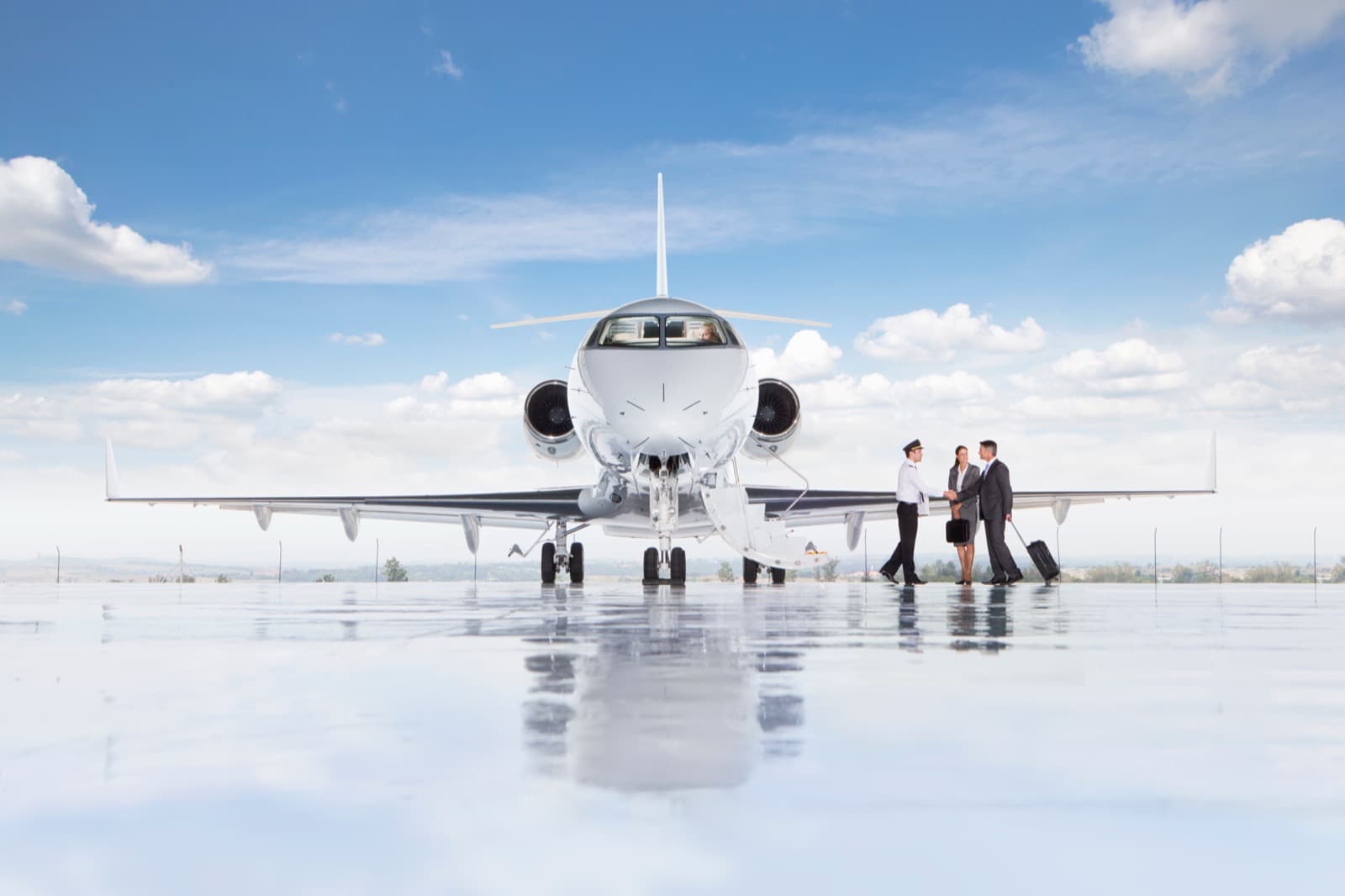
Four hours is the line where the conversation gets interesting. Under three, almost any light jet handles it without complaint. Over five, you're in midsize or super-midsize territory and the math makes itself. But four hours — Nashville to Aspen, Teterboro to Palm Beach with weather, Dallas to Cabo with kids and a dog — that's the band where the decision actually matters, and where the wrong call shows up as a fuel stop, a tight bag count, or a six-year-old who's done with the cabin ninety minutes before you land.
This is how we think about it inside the flight department, when a family of four to six is looking at a four-hour leg and asking the right question, which is never what's cheaper but what's the day going to feel like.
The categories, briefly, and what they actually mean
Light jets and midsize jets are not a continuum. They're two different design philosophies that happen to overlap in advertised range.
A light jet — Citation CJ3, Phenom 300, Learjet 75 — is built for the 1,800 to 2,200 nautical mile mission with a half cabin of passengers. Stand-up height is borderline. The lavatory is usually a curtained belted seat, not an enclosed room. Bag space is real but finite, and it's split between an external compartment and whatever fits inside. The cabin is designed for four to seven adults sitting still, not for a kid building a Lego set on the floor.
A midsize — Citation XLS+, Hawker 800/900, Learjet 60 — gives you a flat-floor stand-up cabin, a real enclosed lav with a door and a sink, more shoulder room per seat, and meaningfully more baggage volume. Range jumps to roughly 2,500 to 3,200 nautical miles depending on payload. The cabin is designed to be lived in for four to six hours.
Super-midsize — Challenger 350, Citation Longitude, Praetor 600 — is a different conversation and usually overkill for a domestic four-hour family trip unless you're crossing terrain or weather that wants the extra performance.
The full breakdown of what we fly and why is on the jets page, but for this decision, light versus midsize is the real fork.
The four variables that decide it
Forget the brochure. There are four things that actually move the needle on a family trip in this range band.
Trip length plus reserves plus weather
Four hours block-to-block is not four hours of fuel burn. You're carrying reserves, you're potentially carrying an alternate, and headwinds in the winter on a westbound leg can add forty-five minutes you didn't plan for. A light jet advertised at 1,900 nm range with four passengers loses real range fast when you load six people, six bags, ski equipment, and file with a 200-mile alternate.
The operational rule we use: if the great-circle distance is more than about 75% of the aircraft's realistic full-passenger range, you're in fuel-stop territory the moment weather moves. A midsize with a 2,800 nm book number gives you a comfortable margin on a 1,600 nm leg. A light jet with a 1,900 nm book number does not.
A fuel stop adds forty-five minutes to an hour, which doesn't sound like much until you've done it with a tired kid.
Passenger count and what they're doing
Four adults sitting still in a CJ3 for four hours is fine. It's a comfortable airplane. Four adults plus two kids, where the kids want to move, eat, change clothes, watch something on a tablet without headphones, and use a real bathroom — that's a different cabin requirement.
The stand-up cabin in a midsize isn't about height. It's about the fact that someone can walk to the lav without everyone else moving their legs. It's about a parent being able to stand and re-settle a kid without a contortion routine. On a four-hour leg with a young family, that single design difference changes the trip more than any other variable.
Bags, gear, and the things you didn't mention
Clients consistently under-report what they're bringing. The trip is described as "a long weekend, just carry-ons," and then the manifest grows: a stroller, a Pack 'n Play, two sets of skis, a garment bag for the wedding, a cooler, the dog crate. None of this is a problem if you're honest about it on the front end.
Light jets typically offer 50 to 65 cubic feet of baggage volume. Midsizes run 70 to 90, sometimes more, and the geometry of the compartment matters as much as the number — a Hawker swallows golf bags and skis in a way a CJ does not.
If you're not sure, send a photo of the pile in the garage to your specialist before you sign. We'd rather right-size the airplane on Tuesday than rebook on Friday morning. That's part of why the quote process starts with a conversation about the trip, not a price sheet.
Airport pairs and runway performance
This is the variable most clients don't think about and the one that sometimes forces the decision. Aspen, Telluride, Sun Valley, Eagle, Hayden — high-altitude western airports have performance restrictions that punish heavier aircraft, especially in summer. A light jet often operates into and out of these fields with fewer payload penalties than a midsize loaded to the same passenger count.
Conversely, some midsize jets need more runway than a small coastal field offers. Operators know this; the dispatch culture around airport selection is one of the things we vet before we ever offer an aircraft to a client.
This is also where empty-leg and one-way pricing gets misleading. A great price on a light jet that has to make a fuel stop on a hot day at altitude is not actually a great price.
How the decision tends to land
After twenty years of this, four-hour family trips sort into three reasonably clean buckets.
Light jet wins when you have four passengers or fewer, normal bag count, the route is well within book range with margin, and the destination airport favors a smaller airframe. Nashville to Naples in February with two adults and two teenagers and reasonable luggage — that's a CJ3 or a Phenom 300 all day, and the cabin is genuinely comfortable for that mission.
Midsize wins when you have five or more passengers, a kid under eight in the group, oversized gear, or a route that flirts with the light jet's realistic range under winter winds. The XLS+ and the Hawker 900 are workhorses for exactly this profile, and the cost delta is smaller than people expect once you account for the avoided fuel stop and the operational margin.
It's actually a super-midsize in a small subset of cases — Pacific Northwest weather, a six-hour leg disguised as a four-hour leg by winter winds, a group of eight, or a client who'll be working the entire flight and needs a cabin that supports it. We'll say so when that's the answer.
The wrong frame is light jet versus midsize as a price comparison. The right frame is what does this specific trip, with these specific people, on this specific day, actually need. Sometimes the light jet is the better airplane and the better number. Sometimes paying for the midsize is the only honest answer. The job of the specialist is to tell you which, and to tell you why, and to be willing to argue the point if you push back for the wrong reasons.
What we ask before we quote
A quote that arrives in eight minutes with no questions asked is a quote built on assumptions. The questions we work through before we put an aircraft against a trip are the same ones any operator should be asking, and if they're not, that's information too.
Where are you going, on what day, with what flexibility on time. Who's on board — names, ages, anyone with mobility considerations, anyone who needs a car seat anchored. What are you bringing, honestly. Are you coming back on the same tail or one-way. Is there a pet. Is there a preference on operator, on cabin layout, on catering. Is there a hard arrival time on the other end — a wedding, a tee time, a school pickup — that changes how we think about weather margin.
None of this is paperwork. It's the conversation that decides whether you're getting on a light jet or a midsize, and it's why we don't quote without it. More on how the collective operates is on the about page, but the short version is: the airplane is the answer to the trip, not the other way around.
FAQ
Is a midsize jet always more expensive than a light jet for the same route?
Usually, but not always, and the gap is smaller than people assume on routes near the light jet's range limit. Once you factor in a likely fuel stop, ground time, and the operational risk of a tight reserve, the all-in cost of the light jet on a marginal route can come within 10 to 15% of the midsize. On a clean route well inside light jet range, the midsize premium is real and the light jet is the right call.
Can a light jet handle a four-hour flight comfortably with kids?
With two kids and two adults, often yes — a Phenom 300 or CJ3 has a cabin that works for that group on a four-hour leg. With three or more kids, or any child young enough to need to move around and use a real bathroom, the midsize cabin is a meaningful upgrade and we usually recommend it. The deciding factor is less the kids' ages than what the cabin needs to do for four straight hours.
What's the real range difference between a light jet and a midsize jet?
Book range on a light jet runs roughly 1,800 to 2,200 nm; midsize runs 2,500 to 3,200 nm. But the operational difference is bigger than the spec sheet suggests, because a fully loaded light jet with bags loses range faster than a midsize at the same payload, and weather margins eat into a tight number first. On a 1,600 to 1,800 nm trip, the midsize gives you a comfortable cushion that the light jet doesn't.
Does the destination airport change which jet we should take?
Yes, and it's one of the most common reasons we recommend a different category than the client expected. High-altitude airports in summer, short runways, and noise-restricted fields all push the decision one way or the other. Aspen, Telluride, and similar western fields often favor light jets. Some coastal fields can't accept certain midsize types at all. The airport pair drives the answer more than people think.
How far in advance should I decide on aircraft category?
For a four-hour domestic trip, two to three weeks gives you the best inventory and pricing. Inside a week, the light versus midsize choice may be made for you by what's actually positioned in the right region. Inside 48 hours, you're working with whatever the network has, and that's when relationships with operators matter most. Reach out through contact when you have dates, even rough ones, and we can start watching inventory.
What if my trip is right at the edge of light jet range?
We usually recommend the midsize, and we'll tell you why in writing. A trip that requires the light jet to run near max range with full passengers gives up almost all of its weather margin and most of its alternate options. The fuel stop you didn't plan for costs more in time and aggravation than the midsize upgrade costs in dollars. This is the single most common scenario where the brochure number and the operational reality diverge.
We don't have a house preference between light and midsize. We have a preference for the airplane that matches the trip, and a habit of saying so plainly. If you've got a four-hour leg on the calendar and you're trying to decide, send the dates and the manifest and we'll work it through with you.